Markets are down 700 points, what should mutual fund investors do?/बाजार 700 अंक नीचे, म्यूचुअल फंड निवेशकों को क्या करना चाहिए?


No need to do anything when the markets are volatile when asked a mutual fund advisor or manager, this is what they will tell you. This might not sound positive as per your expectations and repeats every time the market falls big time, but don’t degrade the advice. The advice is given as per the history of the stock market

If we can't believe or Don’t believe, then-

Here are some similar stories we had seen in past years when there was a major fall in the market

In case one, if Sensex is down nearly 4,000 points in a month: In such a scenario what should mutual fund investors do?

In case number 2, if Sensex falls 900 points; what should mutual fund investors do?

Let me answer for both cases,

You might have seen for yourself what happened in the market after the fall, Any guesswork?

Yes! Time to invest more?

Many Smart investors know and understand that a large fall in the market is a great opportunity to make more money by investment allocation to equity mutual fund schemes. However, mutual fund advisors suggest that investors be careful about allocating to equity mutual funds, and only invest when they don't need the money for at least five to seven years. Also, secondly, they have to remember the point to invest only when the market falls more than 10 percent

What should be the strategy for new investors?

Mutual fund advisors and managers suggest that it is not advisable to make investment decisions based on the prevailing market conditions. If you have a goal and invest in equity schemes to meet your goal via a long-term financial plan, you should go ahead and invest irrespective of the market conditions. To be on the safe side, try to diversify your investments and avoid a lump sum investment

Always take a closer look at your portfolio:

Take the opportunity to evaluate your mutual fund portfolio. Make a note of schemes that are not performing well and are hit in the market fall. Make sure the scheme is as per your risk appetite. If you think you can’t take the extra risk and volatility, rebalance your investment in the scheme.

Stay focused on your goal achievement:

Since there is a pile of bad news floating on the economic media, the market is likely to be volatile in the coming days. There would be experts giving their opinion in different ways and you might feel confused and discouraged. But do not panic and give up, but focus on your goal and be firm, by staying invested for a very long term in the market and creating the required wealth.


म्यूचुअल फंड एडवाइजर या मैनेजर से पूछे जाने पर बाजार में उतार-चढ़ाव होने पर कुछ भी करने की जरूरत नहीं है, वे आपको यही बताएंगे। यह आपकी अपेक्षाओं के अनुसार सकारात्मक नहीं लग सकता है और हर बार बाजार में बड़ी गिरावट आने पर दोहराता है, लेकिन सलाह को नीचा न करें। शेयर बाजार के इतिहास के अनुसार सलाह दी जाती है
अगर हम विश्वास नहीं कर सकते हैं या नहीं कर सकते हैं, तो-

यहां कुछ ऐसी ही कहानियां हैं जो हमने पिछले वर्षों में देखी थीं जब बाजार में बड़ी गिरावट आई थी, अगर एक महीने में सेंसेक्स लगभग 4,000 अंक नीचे आता है: ऐसे में म्यूचुअल फंड निवेशकों को क्या करना चाहिए?

मामले नंबर 2 में अगर सेंसेक्स 900 अंक गिरता है; म्यूचुअल फंड निवेशकों को क्या करना चाहिए? मैं दोनों मामलों का जवाब देता हूं, आपने खुद देखा होगा कि गिरावट के बाद बाजार में क्या हुआ, कोई अनुमान?

हां! अधिक निवेश करने का समय?

कई स्मार्ट निवेशक जानते हैं और समझते हैं कि इक्विटी म्यूचुअल फंड योजनाओं में निवेश आवंटन द्वारा अधिक पैसा बनाने का एक बड़ा अवसर बाजार में गिरावट है। हालांकि, म्यूचुअल फंड एडवाइजर निवेशकों को सलाह देते हैं कि उन्हें इक्विटी म्यूचुअल फंड में आवंटन के बारे में सावधान रहना चाहिए और केवल तभी निवेश करना चाहिए जब उन्हें कम से कम पांच से सात साल तक पैसे की जरूरत न हो। साथ ही, दूसरी बात, उन्हें निवेश करने की बात तभी याद रखनी होगी, जब बाजार में 10 फीसदी से ज्यादा की गिरावट आए

नए निवेशकों के लिए क्या होनी चाहिए रणनीति?


म्युचुअल फंड सलाहकारों और प्रबंधकों का सुझाव है कि मौजूदा बाजार स्थितियों के आधार पर निवेश के निर्णय लेने की सलाह नहीं दी जाती है। यदि आपका कोई लक्ष्य है और लंबी अवधि की वित्तीय योजना के माध्यम से अपने लक्ष्य को पूरा करने के लिए इक्विटी योजनाओं में निवेश करते हैं, तो आपको आगे बढ़ना चाहिए और बाजार की स्थितियों के बावजूद निवेश करना चाहिए। सुरक्षित रहने के लिए, अपने निवेश में विविधता लाने की कोशिश करें और एकमुश्त निवेश से बचें

हमेशा अपने पोर्टफोलियो पर करीब से नज़र डालें:

अपने म्यूचुअल फंड पोर्टफोलियो का मूल्यांकन करने का अवसर लें। उन योजनाओं पर ध्यान दें जो अच्छा प्रदर्शन नहीं कर रही हैं और बाजार में गिरावट का सामना कर रही हैं। सुनिश्चित करें कि योजना आपकी जोखिम उठाने की क्षमता के अनुसार है। अगर आपको लगता है कि आप अतिरिक्त जोखिम और अस्थिरता नहीं उठा सकते हैं, तो योजना में अपने निवेश को पुनर्संतुलित करें।

अपने लक्ष्य प्राप्ति पर केंद्रित रहें:

चूंकि अर्थव्यवस्था मीडिया पर बुरी खबरों का ढेर है, इसलिए आने वाले दिनों में बाजार में उतार-चढ़ाव की संभावना है। ऐसे विशेषज्ञ होंगे जो अलग-अलग तरीकों से अपनी राय देंगे और आप भ्रमित और हतोत्साहित महसूस कर सकते हैं। लेकिन घबराएं नहीं और हार न मानें, बल्कि अपने लक्ष्य पर ध्यान दें और दृढ़ रहें, बाजार में बहुत लंबे समय तक निवेशित रहें और आवश्यक धन का सृजन करें।


Understanding what are Corporate Bonds/कॉर्पोरेट बॉन्ड क्या होते हैं, इसे समझना


     The company always requires money for a variety of purposes. it can be for expansion of its business, for building a new plant, to buy new machinery, for purchasing new land or to build a new factory, The convenient way to raise money is to issue a corporate bond. A year back there was a rise in bond issuances because companies were borrowing more to build cash reserves to protect themselves from the financial crisis caused by the pandemic.

    When you purchase a bond, you lend money to the company that issued the bond. For which, the company promises to return your principal on a predetermined date which is the maturity date, and till then, it will pay you a specified rate of interest which is called the coupon rate.

Let us assume, you invest Rs 10,000 in a 6-year bond, with a coupon rate calculated half-yearly of 5% annually

Having a Face Value of Rs 10,000. This is the amount you loaned to the company and they have a liability to return it on maturity.
With Maturity of 6 years tenure of the bond.
The Coupon Rate of 5% per annum. The Coupon Rate is applied to the bond’s Face Value. ie. 5% of Rs 10,000 = Rs 500 per annum.
Since the payment is to be made on a half-yearly basis, you will receive 2 coupon payments of Rs 250 each.

A corporate bond is a debt obligation agreed by the company by a legal commitment to pay interest on the principal to be paid at the end of the term. No matters the company makes profits or losses, as per the terms and conditions, and has a binding to pay the interest rate promised and return the principal amount on the specified maturity date.
   The ways to invest in corporate bonds are listed below:

  • The first is the direct route which is made by investing in a company's bonds, But many factors are considered when selecting a bond:
Rating agencies (CARE, ICRA, India Ratings, Brickworks, and CRISIL) rate these bonds so that an investor can understand the risk associated with that company bond.
  • The most convenient option is to invest in a corporate bond mutual fund. These funds invest a minimum of 80% of the corpus in AA+ or AAA-rated bonds, which indicate high safety. These investments are made in a diversified manner across companies and sectors.

What is a Bond yield?

Recently, the term yield has been in the headlines. Let us understand what it is all about, here is a quick explanation: 

Bond Yield is the interest rate that is calculated by applying the Coupon Rate to its market price. It is the return you get when you purchase the bond at that given price and hold it up to maturity.
From the above statement, you can understand that the interest rate, also known as the Coupon Rate differs from the bond yield.

        कंपनी को हमेशा विभिन्न उद्देश्यों के लिए धन की आवश्यकता होती है। यह अपने व्यवसाय के विस्तार के लिए, एक नया संयंत्र बनाने के लिए, नई मशीनरी खरीदने के लिए, नई जमीन खरीदने के लिए या एक नया कारखाना बनाने के लिए हो सकता है, धन जुटाने का सुविधाजनक तरीका कॉर्पोरेट बांड जारी करना है। एक साल पहले बांड जारी करने में वृद्धि हुई थी क्योंकि कंपनियां खुद को महामारी के कारण होने वाले वित्तीय संकट से बचाने के लिए नकद भंडार बनाने के लिए अधिक उधार ले रही थीं।
जब आप एक बांड खरीदते हैं, तो आप उस कंपनी को पैसा उधार देते हैं जिसने बांड जारी किया है। जिसके लिए, कंपनी आपके मूलधन को एक पूर्व निर्धारित तिथि पर वापस करने का वादा करती है, जो कि परिपक्वता तिथि है, और तब तक, यह आपको एक निर्दिष्ट ब्याज दर का भुगतान करेगी जिसे कूपन दर कहा जाता है।

मान लीजिए, आप ६ साल के बांड में १०,००० रुपये का निवेश करते हैं, जिसकी कूपन दर ५% वार्षिक की गणना की जाती है। 
जिसका अंकित मूल्य 10,000 रुपये है। यह वह राशि है जो आपने कंपनी को उधार दी थी और परिपक्वता पर इसे वापस करने की उनकी देनदारी है। बांड के 6 साल के कार्यकाल की परिपक्वता के साथ।
बांड के 6 साल के कार्यकाल की परिपक्वता के साथ।
प्रति वर्ष 5% की कूपन दर। कूपन दर बांड के अंकित मूल्य पर लागू होती है। अर्थात। १०,००० रुपये का ५% = ५०० रुपये प्रति वर्ष।
चूंकि भुगतान अर्ध-वार्षिक आधार पर किया जाना है, इसलिए आपको प्रत्येक 250 रुपये के 2 कूपन भुगतान प्राप्त होंगे।

एक कॉरपोरेट बॉन्ड एक ऋण दायित्व है जो कंपनी द्वारा अवधि के अंत में भुगतान किए जाने वाले मूलधन पर ब्याज का भुगतान करने के लिए कानूनी प्रतिबद्धता द्वारा सहमत है। कोई फर्क नहीं पड़ता कि कंपनी नियम और शर्तों के अनुसार लाभ या हानि करती है, और ब्याज दर का भुगतान करने और निर्दिष्ट परिपक्वता तिथि पर मूल राशि वापस करने के लिए बाध्यकारी है।

कॉरपोरेट बॉन्ड में निवेश करने के तरीके नीचे सूचीबद्ध हैं:
  • पहला सीधा रास्ता है जो किसी कंपनी के बॉन्ड में निवेश करके बनाया जाता है, लेकिन बॉन्ड का चयन करते समय कई कारकों पर विचार किया जाता है:
रेटिंग एजेंसियां (CARE, ICRA, India Ratings, Brickworks, और CRISIL) इन बॉन्ड को रेट करती हैं ताकि एक निवेशक उस कंपनी बॉन्ड से जुड़े जोखिम को समझ सके।
  • सबसे सुविधाजनक विकल्प कॉरपोरेट बॉन्ड म्यूचुअल फंड में निवेश करना है। ये फंड एए+ या एएए-रेटेड बॉन्ड में कम से कम 80% कॉर्पस का निवेश करते हैं, जो उच्च सुरक्षा का संकेत देते हैं। ये निवेश कंपनियों और क्षेत्रों में विविध तरीके से किए जाते हैं।

बॉन्ड यील्ड क्या है?

हाल ही में उपज शब्द सुर्खियों में रहा है। आइए समझते हैं कि यह सब क्या है, यहाँ एक त्वरित व्याख्या है:
बॉन्ड यील्ड वह ब्याज दर है जिसकी गणना कूपन दर को उसके बाजार मूल्य पर लागू करके की जाती है। जब आप उस कीमत पर बांड खरीदते हैं और उसे मैच्योरिटी तक रखते हैं तो यह आपको मिलने वाला रिटर्न है।
उपरोक्त कथन से, आप समझ सकते हैं कि ब्याज दर, जिसे कूपन दर के रूप में भी जाना जाता है, बांड प्रतिफल से भिन्न होता  है।

What are Debt Mutual Funds/डेट म्यूचुअल फंड क्या हैं


Let us understand about Debt Mutual Fund Scheme:

A debt fund is a mutual fund scheme that invests within the basket of fixed income instruments, depending on the type of the scheme, they can have bank CDs,(Certificate Of Deposits), Treasury bills, Commercial papers, Corporate bonds, Government Securities, and Money market instruments or of a combination of instruments The example of popular debt funds categories are Overnight funds, Liquid funds, Ultra short term funds, medium duration funds, credit risk fund, Dynamic bond funds, and Government Securities funds. 

The easiest and the convenient way to invest in the debt market is through a debt mutual fund as the name suggests that invests in various debt and money market instruments. for example, a corporate Bond fund which invests at least 80% in the corporate Bond papers, or Banking and PSU fund which has at least 80% in banking and PSU papers, other factors on which the categories are defined is duration which means the portfolio duration is pre-defined by SEBI so that portfolio have to maintain that particular duration let us take an example for Ultra short term, it is mandatory to maintain duration between three months to six months

 Why you should consider investing?

Let us go back 15 to 16 years back, if you remember the fixed deposit rates were around 14 to 15%, but if you look at the current scenario the rates have gone down to around 6 to 7 percent which is a huge difference between the return which used to get 15 years back and return we get today hence we have seen that market has evolved during this period, the rates have come down and there are various other option to invest in debt mutual fund one of the reasons to invest in debt mutual fund is an advantage over is what we had in traditional products one is a better risk-adjusted return, second  is a tax efficiency

How are Debt funds Superior to Traditional Instruments?

Compared with the instrument with Bond funds and Fixed Deposits or the Non-convertible debentures, debt funds help investors to diversify the investor's investments, since the portfolio of the debt funds scheme has a various number of papers which helps to minimize the single-party risks.

In a debt mutual fund, you have to pay tax as per your tax slab, There is no tax deduction at source (TDS) whereas the Fixed Deposits do not have indexation benefits, let us consider the highest bracket of the 30% of taxation if we invest in a debt mutual fund for at least three years, then you get a 20% indexation benefit, which will improve your post taxation returns, there is another reason for investing in debt mutual fund is a potential of higher returns over FD or RD or any traditional instruments in which fixed returns are attached to it but the market is volatile so is the interest rate in the market, you can take the advantage of it for a better potential return, one of the most important reasons we should consider investing in mutual funds is for diversification.

Debt mutual funds give you the balance of volatility in the market as well as the stability of the return. As in the case of equity funds, which has liquidity, but due to the market volatility you are not able to withdraw the money in case you need money, just as in the case of FD's or any traditional investments where you break your entire FD and end up losing your interest rate, whereas in debt mutual funds you break the fund by redeeming the no of units in parts as required of your investments without losing the value of the fund as per the NAV.

Key Risk Factors associated with Debt Funds

There are two major risks in a debt fund. Interest rate risk and credit risk. First, let us understand what is interest rate risk? 
Debt funds invest in debt instruments or bonds. Like stocks, bonds prices also fluctuate up and down, depending on how interest rates are changing. Whenever interest rates fall or People think that the interest rate is going to fall, If there is a high demand, then the price of the bond increases due to high demand.

Let us understand this with an example- suppose a debt fund is holding a bond.
Which pays a 10% annual interest rate. If the interest rates fall in the economy, any new bond coming into the market will give a low-interest rate, 9%. Because of this, the demand for old bonds for those who are giving higher interest rates will increase. This will increase the price of the bond and subsequently hold it.
The NAV of the debt fund increases as the price rises. Similarly, if interest rates go up then the price of the bond will come down because now the demand for these bonds giving low-interest rates will also decrease. The price movement of a bond due to the interest rate fluctuation is called interest rate risk.

Now let us understand the second risk i.e. credit risk. As one knows, our personal credit score such as CIBIL shows how well we have paid off the debts like loans in the past. It gives you a score based on the repayment made by you of the loan Similarly, there are rating agencies for the company as well, These agencies are called credit rating agencies, ie. CRISIL and ICRA. These agencies are responsible for the rating. 'AAA' is the highest rating which shows that the company is almost certain that the company will pay its debt and hence it has low credit risk. 
Next is 'AA' which indicates low accuracy it has slightly higher credit risk. Similarly, this rating goes up to 'D'. 
'D' rating is given when a company has not repaid its loan or it appears that it will not be able to repay the loan.

The best way to avoid this type of risk is to invest in such debt funds that lend to highly rated corporates.


आइए समझते हैं डेट म्यूचुअल फंड स्कीम के बारे में:

एक डेट फंड एक म्यूचुअल फंड योजना है जो निश्चित आय साधनों की टोकरी के भीतर निवेश करती है, योजना के प्रकार के आधार पर, उनके पास बैंक सीडी, (जमा प्रमाणपत्र), ट्रेजरी बिल, वाणिज्यिक पत्र, कॉर्पोरेट बॉन्ड, सरकारी प्रतिभूतियां हो सकती हैं। और मनी मार्केट इंस्ट्रूमेंट्स या इंस्ट्रूमेंट्स के संयोजन लोकप्रिय डेट फंड कैटेगरी के उदाहरण हैं ओवरनाइट फंड्स, लिक्विड फंड्स, अल्ट्रा शॉर्ट टर्म फंड्स, मीडियम ड्यूरेशन फंड्स, क्रेडिट रिस्क फंड, डायनेमिक बॉन्ड फंड्स और गवर्नमेंट सिक्योरिटीज फंड्स।

डेट मार्केट में निवेश करने का सबसे आसान और सुविधाजनक तरीका डेट म्यूचुअल फंड है, जैसा कि नाम से पता चलता है कि यह विभिन्न डेट और मनी मार्केट इंस्ट्रूमेंट्स में निवेश करता है। उदाहरण के लिए, एक कॉरपोरेट बॉन्ड फंड जो कॉरपोरेट बॉन्ड पेपर्स में कम से कम 80% निवेश करता है, या बैंकिंग और पीएसयू फंड जिसमें बैंकिंग और पीएसयू पेपर्स में कम से कम 80% है, अन्य कारक जिन पर श्रेणियों को परिभाषित किया गया है, वह अवधि है जिसका अर्थ है पोर्टफोलियो अवधि सेबी द्वारा पूर्व-परिभाषित है ताकि पोर्टफोलियो को उस विशेष अवधि को बनाए रखना पड़े, आइए हम अल्ट्रा शॉर्ट टर्म के लिए एक उदाहरण लेते हैं, तीन महीने से छह महीने के बीच की अवधि बनाए रखना अनिवार्य है।

आपको निवेश पर विचार क्यों करना चाहिए?

15 से 16 साल पहले की बात करते हैं, अगर आपको याद है कि सावधि जमा दरें लगभग 14 से 15% थीं, लेकिन यदि आप वर्तमान परिदृश्य को देखें तो दरें लगभग 6 से 7 प्रतिशत तक गिर गई हैं जो कि एक बड़ा अंतर है। रिटर्न जो 15 साल पहले मिलता था और आज हमें मिलता है इसलिए हमने देखा है कि इस अवधि के दौरान बाजार विकसित हुआ है, दरें कम हो गई हैं और डेट म्यूचुअल फंड में निवेश करने के कई अन्य विकल्प हैं, जो डेट में निवेश करने का एक कारण है। म्यूचुअल फंड एक फायदा है जो पारंपरिक उत्पादों में हमारे पास था एक बेहतर जोखिम-समायोजित रिटर्न है, दूसरा कर दक्षता है

डेट फंड पारंपरिक साधनों से बेहतर कैसे हैं?

बॉन्ड फंड और फिक्स्ड डिपॉजिट या नॉन-कन्वर्टिबल डिबेंचर के साथ इंस्ट्रूमेंट की तुलना में, डेट फंड निवेशकों को निवेशक के निवेश में विविधता लाने में मदद करते हैं, क्योंकि डेट फंड स्कीम के पोर्टफोलियो में कई तरह के पेपर होते हैं जो सिंगल-पार्टी जोखिम को कम करने में मदद करते हैं। 

डेट म्यूचुअल फंड में, आपको अपने टैक्स स्लैब के अनुसार टैक्स देना होता है, स्रोत पर कोई कर कटौती (टीडीएस) नहीं होती है, जबकि सावधि जमा में इंडेक्सेशन लाभ नहीं होता है, आइए हम कराधान के 30% के उच्चतम ब्रैकेट पर विचार करें यदि हम कम से कम तीन साल के लिए डेट म्यूचुअल फंड में निवेश करते हैं, तो आपको 20% इंडेक्सेशन लाभ मिलता है, जो आपके पोस्ट टैक्सेशन रिटर्न में सुधार करेगा, डेट म्यूचुअल फंड में निवेश करने का एक और कारण एफडी या आरडी पर अधिक रिटर्न की संभावना है। या कोई भी पारंपरिक उपकरण जिसमें निश्चित रिटर्न जुड़ा हुआ है, लेकिन बाजार में उतार-चढ़ाव है, जो की  बाजार के  ब्याज दर में भी  है, आप बेहतर संभावित रिटर्न के लिए इसका लाभ उठा सकते हैं, सबसे महत्वपूर्ण कारणों में से एक जो  हमें निवेश करने पर विचार करना चाहिए वह है , म्यूचुअल फंड विविधीकरण के लिए।

डेट म्यूचुअल फंड आपको बाजार में अस्थिरता के संतुलन के साथ-साथ रिटर्न की स्थिरता भी देते हैं। जैसा कि इक्विटी फंड के मामले में होता है, जिसमें तरलता होती है, लेकिन बाजार की अस्थिरता के कारण आप पैसे की जरूरत पड़ने पर पैसे नहीं निकाल पाते हैं, जैसे कि एफडी या किसी पारंपरिक निवेश के मामले में जहां आप अपनी पूरी एफडी तोड़ देते हैं और अंत में आपकी ब्याज दर कम हो जाती है, जबकि डेट म्यूचुअल फंड में आप एनएवी के अनुसार फंड के मूल्य को खोए बिना अपने निवेश के लिए आवश्यक इकाइयों की संख्या को भागों में भुनाकर फंड को तोड़ते हैं।

डेट फंड से जुड़े प्रमुख जोखिम कारक:

डेट फंड में दो प्रमुख जोखिम होते हैं। ब्याज दर जोखिम और क्रेडिट जोखिम। सबसे पहले, आइए समझते हैं कि ब्याज दर जोखिम क्या है? डेट फंड डेट इंस्ट्रूमेंट्स या बॉन्ड में निवेश करते हैं। स्टॉक की तरह, बॉन्ड की कीमतों में भी ऊपर और नीचे उतार-चढ़ाव होता है, यह इस बात पर निर्भर करता है कि ब्याज दरें कैसे बदल रही हैं। जब भी ब्याज दरें गिरती हैं या लोगों को लगता है कि ब्याज दर गिरने वाली है, यदि मांग अधिक है, तो उच्च मांग के कारण बांड की कीमत बढ़ जाती है।

आइए इसे एक उदाहरण से समझते हैं- 

मान लीजिए कि एक डेट फंड एक बॉन्ड धारण कर रहा है। जो 10% वार्षिक ब्याज दर का भुगतान करता है। अब अगर अर्थव्यवस्था में ब्याज दरें गिरती हैं, तो बाजार में आने वाला कोई भी नया बांड कम ब्याज दर देगा, मान लीजिए 9%। और इस वजह से पुराने बॉन्ड की मांग जो अधिक ब्याज दर दे रहे हैं, उनकी मांग बढ़ेगी। इससे बांड की कीमत बढ़ जाएगी और बाद में इसे धारण कर लिया जाएगा।

कीमत बढ़ने पर डेट फंड का एनएवी बढ़ता है। इसी तरह अगर ब्याज दरें बढ़ती हैं तो बांड की कीमत में कमी आएगी क्योंकि अब कम ब्याज दर देने वाले इन बांडों की मांग भी कम हो जाएगी। ब्याज दर में उतार-चढ़ाव के कारण बांड की कीमत में उतार-चढ़ाव को ब्याज दर जोखिम कहा जाता है।

आइए अब दूसरे जोखिम यानी क्रेडिट जोखिम को समझते हैं:-

जैसा कि कोई जानता है कि हमारा व्यक्तिगत क्रेडिट स्कोर जैसे कि सिबिल दर्शाता है कि हमने अतीत में ऋण जैसे ऋणों का कितनी अच्छी तरह भुगतान किया है। यह आपको ऋण के आपके द्वारा किए गए पुनर्भुगतान के आधार पर एक अंक देता है इसी तरह, कंपनी के लिए भी रेटिंग एजेंसियां ​​हैं, इन एजेंसियों को क्रेडिट रेटिंग एजेंसी कहा जाता है, यानी। क्रिसिल और आईसीआरए। रेटिंग के लिए ये एजेंसियां जिम्मेदार हैं। 'एएए' उच्चतम रेटिंग है जो दर्शाता है कि कंपनी लगभग निश्चित है कि कंपनी अपने कर्ज का भुगतान करेगी और इसलिए इसमें कम क्रेडिट जोखिम है।

अगला 'एए' है जो कम सटीकता को इंगित करता है इसमें थोड़ा अधिक क्रेडिट जोखिम है। इसी तरह यह रेटिंग 'डी' तक जाती है।

'डी' रेटिंग तब दी जाती है जब किसी कंपनी ने अपना कर्ज नहीं चुकाया है या ऐसा लगता है कि वह कर्ज नहीं चुका पाएगी।

इस प्रकार के जोखिम से बचने का सबसे अच्छा तरीका ऐसे डेट फंड में निवेश करना है जो उच्च रेटिंग वाले कॉरपोरेट्स को उधार देते हैं।

Explanation Of The Term 'IDCW' in Mutual Fund/म्यूचुअल फंड में 'IDCW' शब्द की व्याख्या


Many mutual fund investors may have learned about a new term IDCW over the past couple of months and have received emails from Asset Management Companies notifying them about the change in terminology. Some investors could also be conscious of what IDCW is, but there could also be many investors who don't know what this suggests. In this blog post, we will discuss IDCW, and why this alteration was made by SEBI, and what should investors be aware of.

What is IDCW?

IDCW’ is a short form of ‘Income Distribution cum Capital Withdrawal’. In April 2021, SEBI replaced the term “Dividend Option” with “IDCW”. If you had invested in mutual fund Dividend Options previously, which is now changed to IDCW next to the mutual fund scheme name in your account statements. This is only a change in terminology; there's no impact on investors. However, for the point of investor awareness, one should know why SEBI made this change. But first, let us understand what are mutual fund dividends to clear out any misconceptions.


Myths about the Mutual Fund Dividends 

1)   Dividends paid by the mutual funds are the dividends given by their underlying stocks of the schemes. 
Truth – Mutual fund dividends do consist of dividends received by the underlying stocks, but it also includes the profits that are made by selling the stocks of the portfolio of the respective scheme.

2)   Mutual fund dividends are the returns given in addition to the capital appreciation made in the portfolio of the scheme.
Truth – Mutual fund dividends are not the returns paid in addition to capital appreciation, but they pay dividends in place of capital appreciation.

3)   Dividend options of mutual fund schemes book profits to pay regular dividends to the investor.
Truth – The underlying stocks portfolio of growth and dividend options of the mutual fund scheme is the same. Profit booking is done at a scheme level that is applicable for both growth and dividend options. The difference is, in which way the profits are distributed. In the growth option, the profits are reinvested in the scheme; whereas in the dividend option, the decision to distribute the profit made by the scheme to investors is at the discretion of the Asset Management Company


Difference between company(Stocks) dividends and mutual fund dividends

We may observe, mutual fund dividends are similar to dividends paid by companies, however, there are vast differences between the two:-

Companies pay dividends from the Profit After Tax (PAT) after keeping aside a part of the profit as Reserves and Surplus for the future expansion of the company. Later the management takes the decision of the portion of the profits that should be paid as dividends to their shareholders.

In the case of Mutual funds, the dividends are paid from the accumulated surplus profits made by the scheme. The management decides about the dividend payout rate per unit. But whether they pay out the dividend or not, profits made by the scheme always belong to the investors and are reflected in the Net Asset Value (NAV) of the scheme.

The share price of a stock may go up or down by the market sentiments after dividends are declared.
The Net Asset Value(NAV) of a scheme will always decrease after the dividend payout by the mutual fund

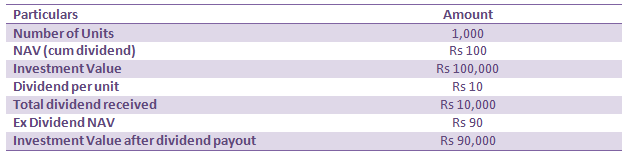
Let us understand the above-mentioned point with the help of an example below. Let's say you have 1,000 units of a mutual fund scheme. The current NAV which we say as cum dividend of the scheme is Rs 100. The scheme declares a dividend of Rs 10 per unit. Let us see how your investment is impacted after the dividend payout.


Disclaimer: Figures in the above example are purely illustrative and for understanding purposes only. Always consult your financial advisor to know the impact of dividends on your mutual fund portfolio value of the different schemes.

From the above, we see that in dividend payout we do not receive any extra income. It is paid out of your mutual fund value. But when you invest in the growth option of the scheme, the value of your investment would have been Rs 100,000 instead of Rs 90,000. And when you invest in shares of a company, you are entitled to get both, dividends as well as share price appreciation. However, in the case of mutual funds, the dividends come out of capital appreciation.

Why SEBI changed the term Dividend to IDCW?

Income Distribution cum Capital Withdrawal refers to the distribution of the income of a mutual fund scheme, which may include both dividends paid by stocks and capital gains made by selling underlying stocks of the scheme. However, SEBI has also emphasized that the income is paid out of your investment value (refer to the example above), alternately, it is a capital withdrawal. The term IDCW is a more exact description of mutual fund dividends which provides clarity to investors so as to make more proper investment decisions and clear their misconceptions


Whether to invest in Growth or IDCW?

An Investor can decide based on the following considerations:-

In the Growth Option, the profits made by the scheme remain invested in the scheme. Over sufficiently long investment tenures, you can earn a profit on profits. by the process of the power of compounding. We have studied in our previous post about the power of compounding as a significant factor in wealth creation.

In IDCW, the profits made by the scheme could also be distributed to the Investors partially or fully at the discretion of the AMC. In which case lose the advantage of compounding. If the investment objective of the investor is purely capital appreciation or wealth creation, you should go with a growth option.
In the case where the investor likes regular cash-flows income from his investments, then he has to choose the IDCW option. However, you ought to remember that income distribution is at the discretion of the AMC. Therefore there is no guaranteed income in mutual funds.

Taxation: Capital gains upon redemptions in growth options are subject to capital gains tax. Short-term capital gains in equity funds (investment holding period of fewer than 12 months) are taxed at 15% (plus applicable surcharge and cess). Long-term capital gains in equity funds (investment holding period of quite 12 months) are tax-exempt up to Rs 100,000 and taxed at 10% (plus applicable surcharge and cess) thereafter.
Dividends received in IDCW are added to your gross taxable income and taxed as per your tax slab rate. From a taxation point of view, IDCW is having a significant disadvantage over the growth option, for investors who are in the higher tax brackets.

कई म्यूचुअल फंड निवेशकों ने पिछले कुछ महीनों में आईडीसीडब्ल्यू (IDCW) के एक नए शब्द के बारे में सीखा होगा और उन्हें एसेट मैनेजमेंट कंपनियों से ईमेल प्राप्त हुए हैं जो उन्हें शब्दावली में बदलाव के बारे में सूचित करते हैं। कुछ निवेशक इस बात से भी अवगत हो सकते हैं कि IDCW क्या है, लेकिन कई निवेशक ऐसे भी हो सकते हैं जो यह नहीं जानते कि इससे क्या पता चलता है। इस ब्लॉग पोस्ट में, हम IDCW पर चर्चा करेंगे, और SEBI द्वारा यह परिवर्तन क्यों किया गया, और निवेशकों को क्या पता होना चाहिए।

आईडीसीडब्ल्यू क्या है?

आईडीसीडब्ल्यू 'आय वितरण सह पूंजी निकासी' का संक्षिप्त रूप है। अप्रैल 2021 में, सेबी ने "डिविडेंड ऑप्शन" शब्द को "IDCW" से बदल दिया। यदि आपने पहले म्यूचुअल फंड डिविडेंड ऑप्शन में निवेश किया था, जिसे अब आपके अकाउंट स्टेटमेंट में म्यूचुअल फंड स्कीम के नाम के आगे IDCW में बदल दिया गया है। यह केवल शब्दावली में परिवर्तन है; निवेशकों पर कोई असर नहीं हालांकि, निवेशकों को जागरूक करने के लिए यह जानना जरूरी है कि सेबी ने यह बदलाव क्यों किया। लेकिन पहले, आइए समझते हैं कि किसी भी गलतफहमी को दूर करने के लिए म्यूचुअल फंड लाभांश क्या हैं।

म्युचुअल फंड लाभांश के बारे में गलतफैमी 

1)   म्युचुअल फंड द्वारा भुगतान किए गए लाभांश योजनाओं के उनके अंतर्निहित शेयरों द्वारा दिए गए लाभांश हैं। 
सच्चाई - म्युचुअल फंड लाभांश में अंतर्निहित शेयरों द्वारा प्राप्त लाभांश शामिल होते हैं, लेकिन इसमें वह लाभ भी शामिल होता है जो संबंधित योजना के पोर्टफोलियो के शेयरों को बेचकर प्राप्त होता है।
2)   म्यूचुअल फंड लाभांश योजना के पोर्टफोलियो में किए गए पूंजी प्रशंसा के अलावा दिया गया रिटर्न है। 
सच्चाई - म्युचुअल फंड लाभांश पूंजीगत प्रशंसा के अतिरिक्त भुगतान किए गए रिटर्न नहीं हैं, लेकिन वे पूंजी प्रशंसा के स्थान पर लाभांश का भुगतान करते हैं।
3)   म्यूचुअल फंड योजनाओं के लाभांश विकल्प निवेशक को नियमित लाभांश का भुगतान करने के लिए मुनाफा बुक करते हैं। 
सच्चाई - म्यूचुअल फंड योजना के विकास और लाभांश विकल्पों का अंतर्निहित स्टॉक पोर्टफोलियो समान है। प्रॉफिट बुकिंग स्कीम के स्तर पर की जाती है जो ग्रोथ और डिविडेंड दोनों विकल्पों पर लागू होती है। अंतर यह है कि लाभ किस प्रकार वितरित किया जाता है। विकास विकल्प में, लाभ को योजना में पुनर्निवेशित किया जाता है; जबकि लाभांश विकल्प में, योजना द्वारा किए गए लाभ को निवेशकों को वितरित करने का निर्णय एसेट मैनेजमेंट कंपनी के विवेक पर होता है।

कंपनी (स्टॉक) लाभांश और म्यूचुअल फंड लाभांश के बीच अंतर

हम देख सकते हैं, म्यूचुअल फंड लाभांश कंपनियों द्वारा भुगतान किए गए लाभांश के समान हैं, हालांकि, दोनों के बीच बहुत बड़ा अंतर है: - 
कंपनियां लाभ के एक हिस्से को रिजर्व और अधिशेष के रूप में अलग रखने के बाद कर के बाद लाभ (पीएटी) से लाभांश का भुगतान करती हैं। कंपनी का भविष्य विस्तार। बाद में प्रबंधन लाभ के उस हिस्से का निर्णय लेता है जिसे उनके शेयरधारकों को लाभांश के रूप में भुगतान किया जाना चाहिए।

म्यूचुअल फंड के मामले में, लाभांश का भुगतान योजना द्वारा किए गए संचित अधिशेष लाभ से किया जाता है। प्रबंधन प्रति यूनिट लाभांश भुगतान दर के बारे में निर्णय लेता है। लेकिन वे लाभांश का भुगतान करते हैं या नहीं, योजना द्वारा अर्जित लाभ हमेशा निवेशकों का होता है और योजना के शुद्ध संपत्ति मूल्य (एनएवी) में परिलक्षित होता है।

लाभांश घोषित होने के बाद शेयर की कीमत बाजार की भावनाओं से ऊपर या नीचे जा सकती है। म्यूचुअल फंड द्वारा लाभांश भुगतान के बाद किसी योजना का शुद्ध संपत्ति मूल्य (एनएवी) हमेशा कम हो जाएगा आइए हम नीचे दिए गए उदाहरण की सहायता से उपर्युक्त बिंदु को समझते हैं। 
मान लीजिए कि आपके पास म्यूचुअल फंड योजना की 1,000 इकाइयां हैं। वर्तमान एनएवी जिसे हम योजना के सह लाभांश के रूप में कहते हैं, 100 रुपये है। यह योजना 10 रुपये प्रति यूनिट के लाभांश की घोषणा करती है। आइए देखें ऊपर दिए गये चार्ट से पता करते है ,कि लाभांश भुगतान के बाद आपका निवेश कैसे प्रभावित होता है।

अस्वीकरण: उपरोक्त उदाहरण में आंकड़े पूरी तरह से उदाहरण हैं और केवल समझने के उद्देश्य से हैं। विभिन्न योजनाओं के आपके म्यूचुअल फंड पोर्टफोलियो मूल्य पर लाभांश के प्रभाव को जानने के लिए हमेशा अपने वित्तीय सलाहकार से परामर्श लें।

उपरोक्त से, हम देखते हैं कि लाभांश भुगतान में हमें कोई अतिरिक्त आय प्राप्त नहीं होती है। यह आपके म्यूचुअल फंड मूल्य से भुगतान किया जाता है। लेकिन जब आप स्कीम के ग्रोथ ऑप्शन में निवेश करते हैं तो आपके निवेश की वैल्यू 90,000 रुपये की जगह 1,00,000 रुपये होती। और जब आप किसी कंपनी के शेयरों में निवेश करते हैं, तो आप लाभांश के साथ-साथ शेयर मूल्य प्रशंसा दोनों प्राप्त करने के हकदार होते हैं। हालांकि, म्युचुअल फंड के मामले में, लाभांश पूंजीगत प्रशंसा से निकलते हैं।


सेबी ने डिविडेंड शब्द को आईडीसीडब्ल्यू में क्यों बदला?

एक निवेशक निम्नलिखित विचारों के आधार पर निर्णय ले सकता है: - 

ग्रोथ ऑप्शन में, योजना द्वारा अर्जित लाभ योजना में निवेशित रहता है। पर्याप्त लंबी निवेश अवधि में, आप मुनाफे पर लाभ कमा सकते हैं। कंपाउंडिंग की शक्ति की प्रक्रिया द्वारा। हमने अपनी पिछली पोस्ट में धन सृजन में एक महत्वपूर्ण कारक के रूप में चक्रवृद्धि की शक्ति के बारे में अध्ययन किया है। 

आईडीसीडब्ल्यू में, एएमसी के विवेक पर योजना द्वारा किए गए लाभ को आंशिक रूप से या पूरी तरह से निवेशकों को वितरित किया जा सकता है। ऐसी स्थिति में कंपाउंडिंग का लाभ खो देते हैं। यदि निवेशक का निवेश उद्देश्य विशुद्ध रूप से पूंजी वृद्धि या धन सृजन है, तो आपको विकास विकल्प के साथ जाना चाहिए। ऐसे मामले में जहां निवेशक को अपने निवेश से नियमित नकदी प्रवाह आय पसंद है, तो उसे आईडीसीडब्ल्यू विकल्प चुनना होगा। हालांकि, आपको यह याद रखना चाहिए कि आय वितरण एएमसी के विवेक पर निर्भर करता है। इसलिए म्यूचुअल फंड में आय की कोई गारंटी नहीं होती है।

ग्रोथ या आईडीसीडब्ल्यू में निवेश करना है या नहीं?

एक निवेशक निम्नलिखित विचारों के आधार पर निर्णय ले सकता है: - 
  • ग्रोथ ऑप्शन में, योजना द्वारा अर्जित लाभ योजना में निवेशित रहता है। पर्याप्त लंबी निवेश अवधि में, आप मुनाफे पर लाभ कमा सकते हैं। कंपाउंडिंग की शक्ति की प्रक्रिया द्वारा। हमने अपनी पिछली पोस्ट में धन सृजन में एक महत्वपूर्ण कारक के रूप में चक्रवृद्धि की शक्ति के बारे में अध्ययन किया है। 
  • आईडीसीडब्ल्यू में, एएमसी के विवेक पर योजना द्वारा किए गए लाभ को आंशिक रूप से या पूरी तरह से निवेशकों को वितरित किया जा सकता है। ऐसी स्थिति में कंपाउंडिंग का लाभ खो देते हैं। यदि निवेशक का निवेश उद्देश्य विशुद्ध रूप से पूंजी वृद्धि या धन सृजन है, तो आपको विकास विकल्प के साथ जाना चाहिए। ऐसे मामले में जहां निवेशक को अपने निवेश से नियमित नकदी प्रवाह आय पसंद है, तो उसे आईडीसीडब्ल्यू विकल्प चुनना होगा। हालांकि, आपको यह याद रखना चाहिए कि आय वितरण एएमसी के विवेक पर निर्भर करता है। इसलिए म्यूचुअल फंड में आय की कोई गारंटी नहीं होती है।
कराधान: विकास विकल्पों में मोचन पर पूंजीगत लाभ पूंजीगत लाभ कर के अधीन हैं। इक्विटी फंड में शॉर्ट टर्म कैपिटल गेन्स (12 महीने से कम की निवेश होल्डिंग अवधि) पर 15% (प्लस लागू सरचार्ज और सेस) पर टैक्स लगता है। इक्विटी फंडों में दीर्घकालिक पूंजीगत लाभ (काफी 12 महीनों की निवेश अवधि) पर 100,000 रुपये तक कर-मुक्त है और उसके बाद 10% (साथ ही लागू अधिभार और उपकर) पर कर लगता है।
IDCW में प्राप्त लाभांश को आपकी सकल कर योग्य आय में जोड़ा जाता है और आपके टैक्स स्लैब दर के अनुसार कर लगाया जाता है। कराधान के दृष्टिकोण से, आईडीसीडब्ल्यू को उच्च कर ब्रैकेट में आने वाले निवेशकों के लिए विकास विकल्प पर एक महत्वपूर्ण नुकसान हो रहा है।

Why Investors should add International investments in your Mutual Fund Portfolio/निवेशकों को आपके म्यूचुअल फंड पोर्टफोलियो में अंतर्राष्ट्रीय निवेश क्यों जोड़ना चाहिए


 Most retail investors in India invest mostly in domestic equity, hybrid, or debt mutual funds. However, awareness of international investments has been growing in recent years. As per Association of Mutual Funds of India data, the total AUM of Fund-of-Funds Overseas was only Rs 2,734 Crores as of 31st March 2020. In the year ending 31st March 2021, AUM in Fund-of-Funds Overseas jumped to Rs 12,408 Crores, almost a five-fold jump in assets (Source: AMFI, as of 31st March 2021). In this blog post, we will discuss the reason to have international investments in your MF Portfolio.

Advantages of International diversification

1)   It Avoids single country risk: Equity mutual funds diversify their stocks or other risks, but if you invest only in domestic equities, in which you are exposed to country risk. Most investors have the tendency to ignore single country risk because the country is their home country. But professional investors should consider this risk when building their mutual fund portfolio. Country risk can be seen in various forms, e.g. natural calamities or disasters, whether or health-related, or geopolitical crises by the threat of war.


2)   It Avoids currency risk: While currency risk which is exchange rate risk plays an important role in country risk, and deserves special attention. While currency risk may not directly impact you, if your spending is in domestic currency, it will impact investors who may have to spend in foreign currency for children’s overseas education, foreign vacation, etc. Currency risk can also impact indirectly in terms of higher inflation. By international diversification, the investor can also take advantage of foreign exchange risk which we will see later.

3)   It provides stability to your portfolio: There is a low correlation of returns of different markets. Investing in global equities can minimize risk to a great extent and bring stability to your portfolio. The fact is not that India has underperformed; India outperformed MSCI World Index in 5 out of the last 11 years (ending 31st December 2020). However, in most years when India underperformed comparatively, MSCI World Index outperformed significantly relatively.  A portfolio comprising both domestic and international equities can bring stability and potentially generate good returns.


4)   Benefits of currency fluctuations: Diversifying the investments into global equities can not only hedge currency risks, but it can also add foreign exchange gains from Indian Rupee (INR) depreciation against US Dollar (USD) or other foreign currencies. In the last 10 years, the INR depreciated at a compounded annual growth rate (CAGR) of 5.9% versus the USD (source: Investing.com,) INR depreciation, has been the only factor that has contributed a significant portion of returns from international investments.

However, international investments have advantages, the investors must also be aware of certain risk factors to make proper investment decisions.

By Country risk: Just like domestic equities carry country risk, equities of a foreign country also carry country risks applied to that country. Risks in emerging markets are usually higher than in developed countries. Investors must take into consideration the risk factors to build their equity portfolio comprising domestic and international equities according to their risk appetite.


By Currency risk: Currency risk can work both ways. While international investments can give higher returns, if the domestic currency (INR) depreciates against the foreign currency (USD), but we can see the opposite effect if the domestic currency appreciates against the foreign currency. One has to understand these effects of currency risks and then invest according to your investment style and risk appetite.

Knowhow of International markets: International investments require knowledge of markets and sectors that cannot be anticipated by staying in India. Domestic fund managers sometimes do not have the skills required to invest in international markets. Investors have to rely on the expertise of global asset managers, who have local market experience and knowledge of investing internationally. Investors should also understand the product they want to invest in and consult with their financial advisors.
     
Mutual funds have solutions for investors who want to invest in international markets without having to invest through a foreign broker to avoid the above-mentioned risk factors. There are various Exchange Traded Funds (ETFs) that invest in international equities, however, the more popular solution, which also provides a wider choice for investments, through Mutual Fund is the Fund-of-Funds for investing in international equities. Investors should consult with financial advisors to know more details about such funds.

भारत में ज्यादातर खुदरा निवेशक ज्यादातर घरेलू इक्विटी, हाइब्रिड या डेट म्यूचुअल फंड में निवेश करते हैं। हालांकि, हाल के वर्षों में अंतरराष्ट्रीय निवेश के बारे में जागरूकता बढ़ रही है। एसोसिएशन ऑफ म्यूचुअल फंड्स ऑफ इंडिया के आंकड़ों के अनुसार, 31 मार्च 2020 तक फंड-ऑफ-फंड्स ओवरसीज का कुल एयूएम केवल 2,734 करोड़ रुपये था। 31 मार्च 2021 को समाप्त होने वाले वर्ष में, फंड-ऑफ-फंड्स ओवरसीज में एयूएम बढ़कर रु। 12,408 करोड़, संपत्ति में लगभग पांच गुना उछाल (स्रोत: AMFI, 31 मार्च 2021 तक)। इस ब्लॉग पोस्ट में, हम आपके एमएफ पोर्टफोलियो में अंतरराष्ट्रीय निवेश करने के कारणों पर चर्चा करेंगे।

अंतर्राष्ट्रीय विविधीकरण के लाभ


1)   यह एकल देश के जोखिम से बचा जाता है: इक्विटी म्यूचुअल फंड अपने स्टॉक या अन्य जोखिमों में विविधता लाते हैं, लेकिन यदि आप केवल घरेलू इक्विटी में निवेश करते हैं, जिसमें आप देश के जोखिम के संपर्क में हैं। अधिकांश निवेशकों में एकल देश के जोखिम को नजरअंदाज करने की प्रवृत्ति होती है क्योंकि देश उनका गृह देश है। लेकिन पेशेवर निवेशकों को अपने म्यूचुअल फंड पोर्टफोलियो का निर्माण करते समय इस जोखिम पर विचार करना चाहिए। देश के जोखिम को विभिन्न रूपों में देखा जा सकता है उदा। प्राकृतिक आपदाएं या आपदाएं जिसमें युद्ध के खतरे से स्वास्थ्य संबंधी, या भू-राजनीतिक संकट हो सकते हैं।

2)   यह मुद्रा जोखिम से बचाता है: जबकि मुद्रा जोखिम जो विनिमय दर जोखिम है, देश के जोखिम में एक महत्वपूर्ण भूमिका निभाता है, और विशेष ध्यान देने योग्य है। जबकि मुद्रा जोखिम सीधे आप पर प्रभाव नहीं डाल सकता है, यदि आपका खर्च घरेलू मुद्रा में है, तो यह उन निवेशकों को प्रभावित करेगा जिन्हें बच्चों की विदेशी शिक्षा, विदेशी अवकाश आदि के लिए विदेशी मुद्रा में खर्च करना पड़ सकता है। मुद्रा जोखिम भी उच्च मुद्रास्फीति के संदर्भ में अप्रत्यक्ष रूप से प्रभावित कर सकता है। . अंतर्राष्ट्रीय विविधीकरण द्वारा, निवेशक विदेशी मुद्रा जोखिम का भी लाभ उठा सकता है जिसे हम बाद में देखेंगे।

3)   यह आपके पोर्टफोलियो को स्थिरता प्रदान करता है: विभिन्न बाजारों के रिटर्न का कम सहसंबंध होता है। वैश्विक इक्विटी में निवेश काफी हद तक जोखिम को कम कर सकता है और आपके पोर्टफोलियो में स्थिरता ला सकता है। तथ्य यह नहीं है कि भारत ने कमजोर प्रदर्शन किया है; भारत ने पिछले 11 वर्षों (31 दिसंबर 2020 को समाप्त) में से 5 वर्षों में MSCI वर्ल्ड इंडेक्स से बेहतर प्रदर्शन किया। हालांकि, ज्यादातर वर्षों में जब भारत ने तुलनात्मक रूप से कमजोर प्रदर्शन किया, एमएससीआई वर्ल्ड इंडेक्स ने अपेक्षाकृत बेहतर प्रदर्शन किया। घरेलू और अंतरराष्ट्रीय दोनों तरह के इक्विटी वाले पोर्टफोलियो में स्थिरता आ सकती है और इसमें अच्छा रिटर्न उत्पन्न करने की क्षमता भी होती है।

4) मुद्रा में उतार-चढ़ाव के लाभ: वैश्विक इक्विटी में निवेश में विविधता लाने से न केवल मुद्रा जोखिमों को कम किया जा सकता है, बल्कि यह अमेरिकी डॉलर (यूएसडी) या अन्य विदेशी मुद्राओं के मुकाबले भारतीय रुपये (INR) के मूल्यह्रास से विदेशी मुद्रा लाभ भी जोड़ सकता है। पिछले 10 वर्षों में, INR का मूल्यह्रास 5.9% बनाम USD (स्रोत: Investing.com,) INR मूल्यह्रास की चक्रवृद्धि वार्षिक वृद्धि दर (CAGR) पर हुआ है, यह एकमात्र ऐसा कारक रहा है जिसने अंतर्राष्ट्रीय से रिटर्न के एक महत्वपूर्ण हिस्से का योगदान दिया है। निवेश।

हालांकि, अंतरराष्ट्रीय निवेश के फायदे हैं, निवेशकों को उचित निवेश निर्णय लेने के लिए कुछ जोखिम कारकों से अवगत होना चाहिए।


देश के जोखिम से: जिस तरह घरेलू इक्विटी में देश का जोखिम होता है, उसी तरह किसी विदेशी देश की इक्विटी भी उस देश पर लागू होने वाले देश के जोखिम को वहन करती है। उभरते बाजारों में जोखिम आमतौर पर विकसित देशों की तुलना में अधिक होते हैं। निवेशकों को अपनी जोखिम उठाने की क्षमता के अनुसार घरेलू और अंतरराष्ट्रीय इक्विटी वाले इक्विटी पोर्टफोलियो का निर्माण करने के लिए जोखिम कारकों को ध्यान में रखना चाहिए।

मुद्रा जोखिम से: मुद्रा जोखिम दोनों तरीकों से काम कर सकता है। जबकि अंतरराष्ट्रीय निवेश उच्च रिटर्न दे सकता है, अगर घरेलू मुद्रा (आईएनआर) विदेशी मुद्रा (यूएसडी) के मुकाबले मूल्यह्रास करती है, लेकिन अगर घरेलू मुद्रा विदेशी मुद्रा के मुकाबले बढ़ती है तो हम विपरीत प्रभाव देख सकते हैं। मुद्रा जोखिमों के इन प्रभावों को समझना होगा और फिर अपनी निवेश शैली और जोखिम लेने की क्षमता के अनुसार निवेश करना होगा।

अंतर्राष्ट्रीय बाजारों की जानकारी: अंतर्राष्ट्रीय निवेश के लिए उन बाजारों और क्षेत्रों के ज्ञान की आवश्यकता होती है जिनका भारत में रहकर अनुमान नहीं लगाया जा सकता है। घरेलू (भारतीय)फंड मैनेजरों के पास कभी-कभी अंतरराष्ट्रीय बाजारों में निवेश करने के लिए आवश्यक कौशल नहीं होते हैं। निवेशकों को वैश्विक परिसंपत्ति प्रबंधकों की विशेषज्ञता पर निर्भर रहना पड़ता है, जिनके पास स्थानीय बाजार का अनुभव और अंतरराष्ट्रीय स्तर पर निवेश करने का ज्ञान होता है। निवेशकों को उस उत्पाद को भी समझना चाहिए जिसमें वे निवेश करना चाहते हैं और अपने वित्तीय सलाहकारों से परामर्श लें।
म्यूचुअल फंड के पास उन निवेशकों के लिए समाधान हैं जो उपरोक्त जोखिम कारकों से बचने के लिए किसी विदेशी ब्रोकर के माध्यम से निवेश किए बिना अंतरराष्ट्रीय बाजारों में निवेश करना चाहते हैं। ऐसे कई एक्सचेंज ट्रेडेड फंड (ईटीएफ) हैं जो अंतरराष्ट्रीय इक्विटी में निवेश करते हैं, हालांकि, अधिक लोकप्रिय समाधान, जो म्यूचुअल फंड के माध्यम से निवेश के लिए व्यापक विकल्प प्रदान करता है, अंतरराष्ट्रीय इक्विटी में निवेश के लिए फंड-ऑफ-फंड है। ऐसे फंडों के बारे में अधिक जानकारी जानने के लिए निवेशकों को वित्तीय सलाहकारों से परामर्श करना चाहिए।


Is there any age limit for investing in ELSS mutual funds? /क्या ईएलएसएस म्यूचुअल फंड में निवेश करने की कोई आयु सीमा है?


ELSS or Equity Linked Saving Scheme is an open-ended equity mutual fund that gives the dual benefits of wealth creation with tax saving. These funds have a compulsory lock-in period of 3 years they invest primarily in equity and equity-related instruments. These funds offer tax benefits under Section 80C of the Income Tax Act 1961. Investments in ELSS can be made using both options SIP and lump-sum. There is no age limit for investing in ELSS.

With falling interest rates of traditional savings schemes like PPF and National Saving Certificates with Section 80C of the income tax Act 1961. ELSS mutual funds as investment options for investors who have moderately high to high-risk appetites. ELSS has the highest power of creating wealth among all 80C investment schemes. Since it has a lock-in period of only 3 years, we can say that ELSS is one of the most liquid investments in the 80C category. ELSS is also very tax-friendly, with has a low effective tax rate on the maturity amount after deduction of 1,50,000 from the taxable income as per 80C. These unique advantages make ELSS the most popular investment option with long-term financial goals such as retirement planning, children’s higher education planning, and Children's marriage, with the added benefit of tax savings.

 ELSS Mutual funds are a better option than PPF

In the above post, we had discussed that Equity Linked Savings Scheme (ELSS), a market-linked investment option, also offers tax savings under Section 80C of Income Tax Act 1961 to a limit of र 1.50 Lakhs per annum. 
From a tax point of view, ELSS, like PPF, is exempt at the time of investment (tax savings under 80C), exempt from tax during the period of the investment, and exempt from tax after maturity (exempt – exempt – exempt). But Unlike PPF, ELSS is subject to market risks however it has the potential to give higher returns. 

Most investments that are eligible for Section 80C have a minimum lock-in period of at least 3 years. Therefore, while making a tax-saving investment, the investor has a long-term investment view. The tenure of PPF is 15 years whereas in   ELSS funds we have a lock-in period of 3 years. If the investing in ELSS is done through SIP, each installment will be locked for 3 years. And from a liquidity perspective, ELSS proves to be the most liquid 80C investment option. However, the post does not suggest that investors should redeem ELSS investment after 3 years, because the longer period you remain invested, the more you earn through the power of compounding. The liquidity of ELSS compared to other 80C investment options is an added advantage.


ईएलएसएस या इक्विटी लिंक्ड सेविंग स्कीम एक ओपन-एंडेड इक्विटी म्यूचुअल फंड है जो टैक्स सेविंग के साथ वेल्थ क्रिएशन का दोहरा लाभ देता है। इन फंडों में 3 साल की अनिवार्य लॉक-इन अवधि होती है, वे मुख्य रूप से इक्विटी और इक्विटी से संबंधित उपकरणों में निवेश करते हैं। ये फंड आयकर अधिनियम 1961 की धारा 80 सी के तहत कर लाभ प्रदान करते हैं। ईएलएसएस में निवेश एसआईपी और एकमुश्त दोनों विकल्पों का उपयोग करके किया जा सकता है। ईएलएसएस में निवेश करने के लिए कोई आयु सीमा नहीं है।

पीपीएफ और नेशनल सेविंग सर्टिफिकेट जैसी पारंपरिक बचत योजनाओं की गिरती ब्याज दरों के साथ आयकर अधिनियम 1961 की धारा 80 सी के साथ। ईएलएसएस म्यूचुअल फंड उन निवेशकों के लिए निवेश विकल्प हैं जो मध्यम से उच्च जोखिम वाले हैं। ELSS में सभी 80C निवेश योजनाओं में धन बनाने की सर्वोच्च शक्ति है। चूंकि इसकी लॉक-इन अवधि केवल 3 वर्ष है, इसलिए हम कह सकते हैं कि ELSS 80C श्रेणी में सबसे अधिक तरल निवेशों में से एक है। ईएलएसएस भी बहुत कर-अनुकूल है, 80सी के अनुसार कर योग्य आय से 1,50,000 की कटौती के बाद परिपक्वता राशि पर कम प्रभावी कर दर है। ये अद्वितीय लाभ कर बचत के अतिरिक्त लाभ के साथ सेवानिवृत्ति योजना, बच्चों की उच्च शिक्षा योजना और बच्चों की शादी जैसे दीर्घकालिक वित्तीय लक्ष्यों के साथ ईएलएसएस को सबसे लोकप्रिय निवेश विकल्प बनाते हैं।

पीपीएफ से बेहतर विकल्प है ईएलएसएस म्यूचुअल फंड

उपरोक्त पोस्ट में, हमने चर्चा की थी कि इक्विटी लिंक्ड सेविंग्स स्कीम (ईएलएसएस), एक बाजार से जुड़ा निवेश विकल्प है, जो आयकर अधिनियम 1961 की धारा 80 सी के तहत प्रति वर्ष 1.50 लाख रुपये की सीमा तक कर बचत प्रदान करता है। कर की दृष्टि से, ईएलएसएस, पीपीएफ की तरह, निवेश के समय (80 सी के तहत कर बचत), निवेश की अवधि के दौरान कर से छूट, और परिपक्वता के बाद कर से छूट (छूट - छूट - छूट) है। लेकिन पीपीएफ के विपरीत, ईएलएसएस बाजार के जोखिमों के अधीन है, हालांकि इसमें उच्च रिटर्न देने की क्षमता है।

अधिकांश निवेश जो धारा 80C के लिए पात्र हैं, उनकी न्यूनतम लॉक-इन अवधि कम से कम 3 वर्ष है। इसलिए, कर-बचत निवेश करते समय, निवेशक का दीर्घकालिक निवेश दृष्टिकोण होता है। पीपीएफ का कार्यकाल 15 वर्ष है जबकि ईएलएसएस फंड में हमारे पास 3 साल की लॉक-इन अवधि होती है। अगर ईएलएसएस में निवेश एसआईपी के जरिए किया जाता है तो हर किस्त 3 साल के लिए लॉक हो जाएगी। और तरलता के दृष्टिकोण से, ELSS सबसे अधिक तरल 80C निवेश विकल्प साबित होता है। हालांकि, पोस्ट यह सुझाव नहीं देती है कि निवेशकों को 3 साल के बाद ईएलएसएस निवेश को भुनाना चाहिए, क्योंकि आप जितनी लंबी अवधि में निवेशित रहेंगे, आप चक्रवृद्धि की शक्ति के माध्यम से उतना ही अधिक कमाते हैं। अन्य 80C निवेश विकल्पों की तुलना में ELSS की तरलता एक अतिरिक्त लाभ है।


Comparison of SIP in Mutual Fund vs Recurring Deposits of Banks/म्यूचुअल फंड बनाम बैंकों की आवर्ती जमा में एसआईपी की तुलना


We have observed that Retail investors have two popular investment choices, one is Bank Fixed Deposits and the other is Mutual Funds which consists of RD or Recurring deposits of banks and SIP of the mutual funds and are deposit plans which can be made from your regular savings which either go to bank RD or mutual fund schemes.RD and SIPs are used by large numbers of investors in India. In this post, we will compare these two plans which will compare SIP vs RD to educate you to make a proper investment decision.

What is SIP?
Let us revise this term as discussed in previous posts. A systematic Investment Plan or SIP is a mutual fund investment plan in which an investor can invest a fixed amount in a scheme of his / her choice at regular intervals (weekly, fortnightly, monthly, etc). To start a SIP, you have to submit an ECS mandate of the bank, along with the SIP application form. Different fund houses have a variety of choices of the debit dates for SIP and processed through the ECS mandate, the selected SIP amount automatically gets debited from your bank on a selected date of the month (as per your intervals of frequency)  and gets invested in the scheme of your choice until you stop the SIP. Minimum SIP amounts start with Rs 500 or 1000 as per the scheme.


What is RD?
If you compare SIP vs RD, RD is a term deposit plan offered by banks in which you can make regular deposits and get interested in it. The RD term can range from 6 months to 10 years. To open an RD account of the bank, you need to submit a standing instruction to your bank to debit a fixed amount from your savings account and credit it to the RD account. The interest rates of RD and FD are nearly the same if both have the same tenure, Interest earned by RD keeps accruing and is paid in lump sum along with the principal amount on maturity. Depending on the amount of interest earned, the bank may deduct TDS on interest from your RD account. RD interest is taxed as per the income tax bracket rate of the investor.

Let us find out further the similarities between Recurring deposits & SIP
1)  There is no need to invest a large sum of money in SIP and RD and can be started from your regular savings.
2)  Both are long-term investments if the investor opts for.
3)  Both help to develop the habit of savings in investors who are starting early in their careers and do not have a large amount of surplus.
4)  Both offer a high degree of flexibility. And has the option of terminating or stopping the  SIP and RD at any time and withdraw the money. However, banks may charge penalties for premature withdrawals as per the past period from your RD account.
5)   Both offer the convenience of standing instructions, of a fixed sum to be debited from your savings bank on a selected date, and to be invested either in mutual fund SIP or RD.


Difference between SIP and RD

  • The difference between SIP and RD is relative to the underlying asset. The underlying asset in the SIP is a particular mutual fund scheme, whereas in the case of  RD, is a bank term deposit. 
  • RD assures the capital safety of the principal and interest accrued on the maturity amount of your RD. Mutual funds SIPs are subject to market risks. There is no assurance of capital safety in SIP.
  • RD gives assured interest. The interest paid by an RD is fixed for the investment term and is paid out on maturity. Mutual fund SIPs are market-linked. There is no assurance of returns in SIPs. SIP returns are calculated on the performance of the underlying assets of the mutual fund.
Applicable Tax Liability:

RD interest is taxed every year for the tenure of the investment. 
RD interest earned in a financial year is added to your income at the time of filing tax returns and pay income tax accordingly.
SIP returns are not taxable, during the investment tenure. occurrence of taxation in SIP arises only when redemption is done, however, if you opt for the dividend option in SIPs, then dividends paid to you will be added to your taxable income and taxed as per your income tax slab.
Long-term capital gains in equity mutual fund SIPs (investment holding period of 12 months or more) are tax-exempt up to Rs 1 lakh in an FY and taxed at 10% thereafter. Long-term capital gains in debt funds (investment holding period of 36 months or more) are taxed at 20% after allowing for indexation benefits.

हमने देखा है कि खुदरा निवेशकों के पास दो लोकप्रिय निवेश विकल्प हैं, एक है बैंक सावधि जमा और दूसरा है म्युचुअल फंड जिसमें बैंकों की आरडी या आवर्ती जमा और म्यूचुअल फंड की एसआईपी शामिल हैं और ये जमा योजनाएं हैं जो आपकी नियमित बचत से बनाई जा सकती हैं जो या तो बैंक आरडी या म्यूचुअल फंड योजनाओं में जाते हैं। भारत में बड़ी संख्या में निवेशकों द्वारा आरडी और एसआईपी का उपयोग किया जाता है। इस पोस्ट में, हम इन दो योजनाओं की तुलना करेंगे जो आपको उचित निवेश निर्णय लेने के लिए शिक्षित करने के लिए एसआईपी बनाम आरडी की तुलना करेंगे।

एसआईपी क्या है?


आइए हम इस शब्द को संशोधित करें जैसा कि पिछली पोस्ट में चर्चा की गई है। एक व्यवस्थित निवेश योजना या एसआईपी एक म्यूचुअल फंड निवेश योजना है जिसमें एक निवेशक नियमित अंतराल (साप्ताहिक, पाक्षिक, मासिक, आदि) पर अपनी पसंद की योजना में एक निश्चित राशि का निवेश कर सकता है। एसआईपी शुरू करने के लिए, आपको एसआईपी आवेदन पत्र के साथ बैंक का ईसीएस मैंडेट जमा करना होगा। विभिन्न फंड हाउसों के पास एसआईपी के लिए डेबिट तिथियों के कई विकल्प होते हैं और ईसीएस मैंडेट के माध्यम से संसाधित होते हैं, चयनित एसआईपी राशि स्वचालित रूप से आपके बैंक से महीने की एक चयनित तिथि (आपके आवृत्ति के अंतराल के अनुसार) पर डेबिट हो जाती है और इसमें निवेश किया जाता है जब तक आप SIP बंद नहीं कर देते, तब तक अपनी पसंद की स्कीम। योजना के अनुसार न्यूनतम एसआईपी राशि 500 या 1000 रुपये से शुरू होती है।

आरडी क्या है? 

यदि आप एसआईपी बनाम आरडी की तुलना करते हैं, तो आरडी बैंकों द्वारा दी जाने वाली एक सावधि जमा योजना है जिसमें आप नियमित जमा कर सकते हैं और इसमें रुचि ले सकते हैं। RD टर्म 6 महीने से लेकर 10 साल तक हो सकता है। बैंक का आरडी खाता खोलने के लिए, आपको अपने बचत खाते से एक निश्चित राशि डेबिट करने और आरडी खाते में जमा करने के लिए अपने बैंक को एक स्थायी निर्देश जमा करना होगा। आरडी और एफडी की ब्याज दरें लगभग समान हैं यदि दोनों का कार्यकाल समान है, आरडी द्वारा अर्जित ब्याज अर्जित होता रहता है और परिपक्वता पर मूल राशि के साथ एकमुश्त भुगतान किया जाता है। अर्जित ब्याज की राशि के आधार पर, बैंक आपके आरडी खाते से ब्याज पर टीडीएस काट सकता है। आरडी ब्याज पर निवेशक की आयकर ब्रैकेट दर के अनुसार कर लगाया जाता है।

आइए आगे जानें आवर्ती जमा और एसआईपी के बीच समानताएं :

1)  एसआईपी और आरडी में बड़ी राशि का निवेश करने की आवश्यकता नहीं है और इसे आपकी नियमित बचत से शुरू किया जा सकता है। 
2)  यदि निवेशक विकल्प चुनता है तो दोनों लंबी अवधि के निवेश हैं। 
3)  दोनों ही उन निवेशकों में बचत की आदत विकसित करने में मदद करते हैं जो अपने करियर की शुरुआत कर रहे हैं और जिनके पास बड़ी मात्रा में अधिशेष नहीं है। 
4)  दोनों उच्च स्तर की लचीलापन प्रदान करते हैं। और किसी भी समय एसआईपी और आरडी को समाप्त या बंद करने और पैसे निकालने का विकल्प है। हालांकि, बैंक आपके आरडी खाते से पिछली अवधि के अनुसार समय से पहले निकासी के लिए दंड लगा सकते हैं। 
५)   दोनों स्थायी निर्देशों की सुविधा प्रदान करते हैं, एक निश्चित तिथि पर आपके बचत बैंक से डेबिट की जाने वाली एक निश्चित राशि, और म्यूचुअल फंड एसआईपी या आरडी में निवेश करने के लिए।

एसआईपी और आरडी के बीच अंतर क्या है ?

 एसआईपी और आरडी के बीच का अंतर अंतर्निहित परिसंपत्ति के सापेक्ष है। 
  • एसआईपी में अंतर्निहित परिसंपत्ति एक विशेष म्यूचुअल फंड योजना है, जबकि आरडी के मामले में, एक बैंक सावधि जमा है। 
  • आरडी आपके मूलधन की पूंजी सुरक्षा और आपकी आरडी की परिपक्वता राशि पर अर्जित ब्याज का आश्वासन देता है। म्युचुअल फंड एसआईपी बाजार जोखिम के अधीन हैं। SIP में पूंजी सुरक्षा का कोई आश्वासन नहीं होता है। 
  • आरडी सुनिश्चित ब्याज देता है। RD द्वारा भुगतान किया गया ब्याज निवेश अवधि के लिए निर्धारित होता है और परिपक्वता पर भुगतान किया जाता है। म्यूचुअल फंड एसआईपी बाजार से जुड़े होते हैं। SIP में रिटर्न की कोई गारंटी नहीं होती है। एसआईपी रिटर्न की गणना म्यूचुअल फंड की अंतर्निहित परिसंपत्तियों के प्रदर्शन पर की जाती है।

लागू कर देयता:

निवेश की अवधि के लिए हर साल आरडी ब्याज पर कर लगाया जाता है।
एक वित्तीय वर्ष में अर्जित आरडी ब्याज टैक्स रिटर्न दाखिल करते समय आपकी आय में जोड़ा जाता है और उसी के अनुसार आयकर का भुगतान करता है।
निवेश अवधि के दौरान एसआईपी रिटर्न कर योग्य नहीं हैं। एसआईपी में कराधान की घटना तभी होती है जब मोचन किया जाता है, हालांकि, यदि आप एसआईपी में लाभांश विकल्प चुनते हैं, तो आपको भुगतान किया गया लाभांश आपकी कर योग्य आय में जोड़ा जाएगा और आपके आयकर स्लैब के अनुसार कर लगाया जाएगा।
इक्विटी म्यूचुअल फंड एसआईपी (12 महीने या उससे अधिक की निवेश अवधि) में दीर्घकालिक पूंजीगत लाभ एक वित्त वर्ष में 1 लाख रुपये तक कर-मुक्त है और उसके बाद 10% कर लगाया जाता है। इंडेक्सेशन बेनिफिट्स की अनुमति के बाद डेट फंड्स में लॉन्ग टर्म कैपिटल गेन (36 महीने या उससे ज्यादा की इन्वेस्टमेंट होल्डिंग पीरियड) पर 20% टैक्स लगता है।

Power Of Compounding In Investments /निवेश में कंपाउंडिंग की शक्ति


What is compounding?

The term Compounding is basically used for interest calculated on interest or profit earned on profit. The principal amount that remains invested compounds in value. Appreciation of the principal invested amount and grows the investment value which in turn increases the earnings you earn, as the investment amount increases over time. Over a long investment horizon the original investment amount is only a small percentage of the total investment value; profits earned on profits constitute the major part of the investment value. The power of compounding can be quite effective for those who start investment early - As per the chart below. You can find out that your wealth is not growing linearly but exponentially over time. This is known as the Power of the Compounding effect.


How do you acquire the power of compounding?
 The answer to this is very simple. You have to start saving and investing from the early stages of your life. Even if your income is low in the early working stages, in these stages you have fewer financial obligations compared to later stages of life when you have a family to take care of, moreover, you give your investments a valuable ingredient to meet your financial goals in long-term

Investments Strategy for reference as per Financial Goals

                
               The above table is only for comparison purposes. There can be no guarantee of return


Starting early holds the key to a large corpus that would allow you to plan your goal of retirement

A question is asked by  an investor, When should I start investing for retirement?’ The answer to the question would be The day you earned your first got salary or some income. When we start working. If you remember the day of your first work, which means that in the future you would retire. On retirement, we all will be needing some money that will feed us when our income stops.

A person who has sown seed will know that all seeds will not blossom after a certain time  Many will fail to become large trees. This example can be compared with our savings that may suddenly be wiped out on account of contingencies such as income loss due to a bad economy or health-related expenses

As we observe that sometimes, our investment decisions go wrong, we may end up investing in an instrument that fails to deliver returns. Let us find out with an example of a mutual fund scheme where investment decisions by the fund manager sometimes go wrong; by the time they are changed it can be too late, and If we have invested in such schemes, we may incur a loss of our savings

However, if these losses happen at the start of our careers, we would have the time to rectify them.

What will happen to an investor who has to face such a situation with his retirement money?


Hence, the sooner we start our retirement planning, the better it is.
Here, we notice that those who start saving in the early stages create a much larger corpus than those who start late. the important factor is not the rate of return but how long we are investing.

For calculating compound interest, the important factor is ‘n’ i.e. the number of years we keep investing and not ‘ROI' which is the rate of return, as we've seen in the formula of the last post

Albert Einstein has said that compounding is the eighth wonder of the world. The longer the investment, the greater will be the compounding. Investment is a habit. So, we should always develop the habit in an early stage of life.

Let us also see this concept from the perspective of various stages of life of a person,  At a younger age, there are very few responsibilities. as there are no dependents in many cases. Sometimes parents could be working or independently generating an income. An individual is most of the time be living with his/her parents, so there would be very less household expenses. You may not also experience the need to purchase a house independently.

In such a situation, it is easy to save at this stage. As we grow in life, parents can be dependent, one’s own family would also need support, and there may be a necessity for a house purchase, and so on so forth.

Comparison of Simple & Compound Interest:
Though Compounding takes time. Consider Rs 10,000 investment which earns 5% a year under both simple and compound interest. After ten years simple interest would turn the initial amount of Rs 10,000 into Rs 15,000, by simply adding 5% every year in Rs 10,000. As we can see, in compound interest by adding interest on interest at 5% we see a significant pull ahead of Rs 16,289, however, the difference is small and seemingly insignificant. But as when we go ahead to calculate for 50 years, we can see the vast difference in the amount as compared to the amount earned in simple interest. After fifty years simple interest would turn the initial amount of Rs 35,000, by simply adding 5%, and in compound interest, by adding interest on interest at 5% we see a significant rise of Rs 1,14,674. So friends I hope you have understood the importance of the Compounding effect.

The above example is only given for the understanding purpose


कम्पाउंडिंग क्या है?

कंपाउंडिंग शब्द मूल रूप से ब्याज या लाभ पर अर्जित लाभ पर गणना किए गए ब्याज के लिए उपयोग किया जाता है। मूलधन जो मूल्य में निवेशित यौगिक रहता है। मूलधन निवेशित राशि की सराहना और निवेश मूल्य बढ़ता है जो बदले में आपकी कमाई को बढ़ाता है, क्योंकि निवेश राशि समय के साथ बढ़ती है। एक लंबी निवेश अवधि में मूल निवेश राशि कुल निवेश मूल्य का केवल एक छोटा प्रतिशत है; मुनाफे पर अर्जित लाभ निवेश मूल्य का प्रमुख हिस्सा है। कंपाउंडिंग की शक्ति उन लोगों के लिए काफी प्रभावी हो सकती है जो जल्दी निवेश शुरू करते हैं - ऊपर  दिए गए चार्ट के अनुसार। आप पता लगा सकते हैं कि आपका धन समय के साथ रैखिक रूप से नहीं बल्कि तेजी से बढ़ रहा है। इसे कंपाउंडिंग प्रभाव की शक्ति के रूप में जाना जाता है।


आप कंपाउंडिंग की शक्ति कैसे प्राप्त करते हैं? इसका उत्तर बहुत ही सरल है। आपको अपने जीवन के शुरुआती दौर से ही बचत और निवेश की शुरुआत करनी होगी। यहां तक ​​कि अगर शुरुआती कामकाजी चरणों में आपकी आय कम है, तो इन चरणों में आपके पास जीवन के बाद के चरणों की तुलना में कम वित्तीय दायित्व होते हैं, जब आपके पास देखभाल करने के लिए एक परिवार होता है, इसके अलावा, आप अपने निवेश को अपने वित्तीय लक्ष्यों को पूरा करने के लिए एक मूल्यवान घटक देते हैं। लंबे समय में। 
जल्दी शुरू करना एक बड़े कोष की कुंजी है जो आपको सेवानिवृत्ति के अपने लक्ष्य की योजना बनाने की अनुमति देगा। 

एक निवेशक द्वारा एक प्रश्न पूछा जाता है, मुझे सेवानिवृत्ति के लिए निवेश कब शुरू करना चाहिए?’ इस प्रश्न का उत्तर होगा जिस दिन आपने अपना पहला वेतन या कुछ आय अर्जित की थी। जब हम काम करना शुरू करते हैं। अगर आपको अपने पहले काम का दिन याद है, जिसका मतलब है कि भविष्य में आप रिटायर हो जाएंगे। सेवानिवृत्ति पर, हम सभी को कुछ धन की आवश्यकता होगी जो हमारी आय बंद होने पर हमें खिलाएगा।
एक व्यक्ति जिसने बीज बोया है उसे पता होगा कि एक निश्चित समय के बाद सभी बीज नहीं खिलेंगे कई बड़े पेड़ बनने में असफल होंगे। इस उदाहरण की तुलना हमारी बचत से की जा सकती है जो अचानक खराब अर्थव्यवस्था या स्वास्थ्य संबंधी खर्चों के कारण आय हानि जैसी आकस्मिकताओं के कारण समाप्त हो सकती है।

जैसा कि हम देखते हैं कि कभी-कभी, हमारे निवेश के फैसले गलत हो जाते हैं, हम एक ऐसे साधन में निवेश कर सकते हैं जो रिटर्न देने में विफल रहता है। आइए एक म्यूचुअल फंड स्कीम के उदाहरण से पता करें जहां फंड मैनेजर द्वारा निवेश के फैसले कभी-कभी गलत हो जाते हैं; जब तक उन्हें बदला जाता है तब तक बहुत देर हो चुकी होती है, और अगर हमने ऐसी योजनाओं में निवेश किया है, तो हमें अपनी बचत का नुकसान हो सकता है।
हालांकि, अगर ये नुकसान हमारे करियर की शुरुआत में होते हैं, तो हमारे पास उन्हें सुधारने का समय होगा। उस निवेशक का क्या होगा जिसे अपने रिटायरमेंट के पैसे से ऐसी स्थिति का सामना करना पड़ता है?
इसलिए, जितनी जल्दी हम अपनी सेवानिवृत्ति योजना शुरू करें, उतना ही बेहतर है। यहां, हम देखते हैं कि जो लोग शुरुआती चरणों में बचत करना शुरू करते हैं, वे देर से शुरू करने वालों की तुलना में बहुत बड़ा कोष बनाते हैं। महत्वपूर्ण कारक रिटर्न की दर नहीं है लेकिन हम कब तक निवेश कर रहे हैं।
चक्रवृद्धि ब्याज की गणना के लिए, महत्वपूर्ण कारक है 'n' यानी जितने वर्षों तक हम निवेश करते रहते हैं न कि 'ROI' जो कि प्रतिफल की दर है, जैसा कि हमने पिछले पोस्ट के सूत्र में देखा है। 

अल्बर्ट आइंस्टीन ने कहा है कि कंपाउंडिंग दुनिया का आठवां अजूबा है। निवेश जितना लंबा होगा, कंपाउंडिंग उतनी ही अधिक होगी। निवेश एक आदत है। इसलिए, हमें हमेशा जीवन के प्रारंभिक चरण में आदत विकसित करनी चाहिए।
आइए इस अवधारणा को एक व्यक्ति के जीवन के विभिन्न चरणों के दृष्टिकोण से भी देखें, छोटी उम्र में बहुत कम जिम्मेदारियां होती हैं। क्योंकि कई मामलों में कोई आश्रित नहीं होता है। कभी-कभी माता-पिता काम कर रहे होते हैं या स्वतंत्र रूप से आय अर्जित करते हैं। एक व्यक्ति ज्यादातर समय अपने साथ रहता है ऐसे में इस स्तर पर बचत करना आसान है। जैसे-जैसे हम जीवन में बढ़ते हैं, माता-पिता निर्भर हो सकते हैं, अपने परिवार को भी समर्थन की आवश्यकता होगी, और घर खरीदने की आवश्यकता हो सकती है, इत्यादि।


साधारण और चक्रवृद्धि ब्याज की तुलना :

हालांकि कंपाउंडिंग में समय लगता है। 10,000 रुपये के निवेश पर विचार करें जो साधारण और चक्रवृद्धि ब्याज दोनों के तहत सालाना 5% कमाता है। दस साल के बाद साधारण ब्याज 10,000 रुपये की शुरुआती राशि को 15,000 रुपये में बदल देगा, हर साल 10,000 रुपये में केवल 5% जोड़कर। जैसा कि हम देख सकते हैं, चक्रवृद्धि ब्याज में ब्याज पर 5% की दर से ब्याज जोड़कर हम 16,289 रुपये के आगे एक महत्वपूर्ण खिंचाव देखते हैं, हालांकि, अंतर छोटा और प्रतीत होता है कि महत्वहीन है। लेकिन जब हम 50 वर्षों की गणना के लिए आगे बढ़ते हैं, तो हम साधारण ब्याज में अर्जित राशि की तुलना में राशि में भारी अंतर देख सकते हैं। पचास वर्षों के बाद साधारण ब्याज 35,000 रुपये की प्रारंभिक राशि को केवल 5% जोड़ देगा, और चक्रवृद्धि ब्याज में, 5% पर ब्याज जोड़ने पर हम 1,14,674 रुपये की उल्लेखनीय वृद्धि देखते हैं। 
तो दोस्तों मुझे उम्मीद है कि आपको कम्पाउंडिंग इफ़ेक्ट  का महत्व समझ में आ गया होगा। 

  Why should investors invest in Gold and Silver ETF Fund of Fund? Mutual funds schemes track some market index or price of commodities e.g....